
Large within-population genetic diversity of the widespread conifer Pinus sylvestris at its soil fertility limit
10:39 03.12.2015
Scots pine (Pinus sylvestris) is the only pine species native to northern Europe, and it is the most common tree species in the Baltic states. In Estonia, P. sylvestris covers almost 38% of Estonian forests and it is the key dominant species, especially in nutrient-limited sites, including characteristic Estonian extremely infertile raised bogs.
In this study, the researchers at the Estonian University of Life Sciences teamed up with Brazilian, Iranian and Swiss colleagues to study genetic variability and population structure of P. sylvestris in distant naturally-seeded bog populations positioned at the fertility limit of this species. The team hypothesized that there is a high level of outbreeding and consequently a high genetic variability at the nutrient limit of the species, and further that there is a spatial gradient in genetic relatedness indicative of the genetic component of phenotypic plasticity in the organic-mineral soil continuum. These hypotheses were partly supported by data that indicated greater within- than among-population variability and a certain spatial population structuring, reflecting small-scale adaptation. This study provides important insight into the overall genetic variability and sub-population differentiation in nutrient-limited sites. This information is of crucial value in understanding species adaptability to environmental heterogeneity and has important practical applications in selecting plant sources suitable for reforestation. Especially for reforestation of nutrient-limited habitats, e.g., degraded habitats where tree growth is particularly strongly curbed by limited soil fertility. The study was published in leading forestry journal European Journal of Forest Research.
For more information: Ülo Niinemets ([email protected])
Pazouki L, Salehi Shanjani P, Fields PD, Martins K, Suhhorutšenko M, Viinalass H, Niinemets Ü (2015) Large within-population genetic diversity of the widespread conifer Pinus sylvestris at its soil fertility limit characterized by nuclear and chloroplast microsatellite markers. European Journal of Forest Research, DOI: 10.1007/s10342-015-0928-5
How ENVIRON has contributed to understanding adaptation to global change
11:04 30.09.2015
Ecosystems have a large capacity to adapt to environmental perturbations, but so far, most of the future projections of global change effects do not consider the adaptation responses. This is a key shortcoming of current model predictions as adaptation responses can alter global carbon and nitrogen cycle as well as vegetation capacity to emit volatile organic compounds and contribute to secondary organic aerosol formation, with potentially important implications for the extent and rate of global change.
Likewise, little is known of adaptation of vegetation-mediated emissions of greenhouse gases other than CO2 and the relationships of these emissions to soil microbiological community composition and adaptability. Thus, understanding the capacity of ecosystems to adapt to environmental modifications is the key to predict ecosystem responses to global change. The Center of Excellence on Environmental Adaptation to Global Change (ENVIRON) is a truly interdisciplinary consortium that was formed in 2011 to address the adaptation of terrestrial ecosystems to environmental alterations.
The specific foci of the work program were the effects of globally changing environmental drivers on biological activities ecosystems and the feedbacks between soil, vegetation, and biotic interactions and atmospheric processes. In the core of the proposed centre of excellence was the Estonian Science Roadmap Initiative project „Estonian Environmental Observatory“. In frames of this large infrastructure project of national significance, unique experimental facilities had become available, including establishment of a SMEAR (Station for Measuring Forest Ecosystem – Atmosphere Relations) station, and updating a FAHM (Free Air Humidity Manipulation) platform, allowing for direct monitoring of soil-vegetation-atmosphere feedbacks and assessment of the influences of a potential global change driver, air humidity, on forest ecosystems. In addition, the partners were using lab-based facilities for studying phylogenetic and functional diversity of soil micro-organisms as well as pathogens and pests.
Genetic resources such as large collection of Arabidopsis ecotypes and recombinant inbred and near isogenic lines as well as collection of wheat cultivars and introgressed lines, and Populus and Salix genotypes were used to address molecular mechanisms behind natural variation to different abiotic and biotic stresses. Biotic stress studies considered both the effects of pathogens (plant viruses, different powdery mildew genotypes, rust fungi) and the effects of herbivores. The work conducted is currently being used to scale from molecular stress response mechanisms to ecosystem adaptation by modeling effects of abiotic and biotic stress at phenotypic, physiological and molecular levels to reveal the scope and mechanisms of stressor action and determining limits of adaptation to multiple sequential an interacting stresses.
The major outcomes of ENVIRON include: (i) identification of key mechanisms controlling adaptation to abiotic and biotic stress factors and their interactions under global change, (ii) mapping molecular mechanisms of and adaptation to stress-induced events at major functional levels, (iii) prediction of the adaptation of carbon, nitrogen and water balances of terrestrial ecosystems in globally changing environmental conditions.
Ülo Niinemets
Institute of Agricultural and Environmental Sciences, Estonian University of Life Sciences, Kreutzwaldi 1, Tartu 51014, Estonia
A new publication
A worldwide analysis of within-canopy variations in leaf structural, chemical and physiological traits across plant functional types
Extensive within-canopy light gradients importantly affect the photosynthetic productivity of leaves in different canopy positions and lead to light-dependent increases in foliage photosynthetic capacity per area (AA). However, the controls on AA variations by changes in underlying traits are poorly known. We constructed an unprecedented worldwide database including 831 within-canopy gradients with standardized light estimates for 304 species belonging to major vascular plant functional types, and analyzed within-canopy variations in 12 key foliage structural, chemical and physiological traits by quantitative separation of the contributions of different traits to photosynthetic acclimation. Although the light-dependent increase in AA is surprisingly similar in different plant functional types, they differ fundamentally in the share of the controls on AA by constituent traits. Species with high rates of canopy development and leaf turnover, exhibiting highly dynamic light environments, actively change AA by nitrogen reallocation among and partitioning within leaves. By contrast, species with slow leaf turnover exhibit a passive AA acclimation response, primarily determined by the acclimation of leaf structure to growth light. This review emphasizes that different combinations of traits are responsible for within-canopy photosynthetic acclimation in different plant functional types, and solves an old enigma of the role of mass- vs area-based traits in vegetation acclimation.
Niinemets, Ü., Keenan, T. F. ja Hallik, L. 2014. Tansley review. A worldwide analysis of within-canopy variations in leaf structural, chemical and physiological traits across plant functional types, The New Phytologist: http://onlinelibrary.wiley.com/doi/10.1111/nph.13096/abstractlink opens in new page
ENVIRON open seminar, 28 April 2014, 14.15 - 16.30 Chemicum
ENVIRON open seminar, 10 March 2014
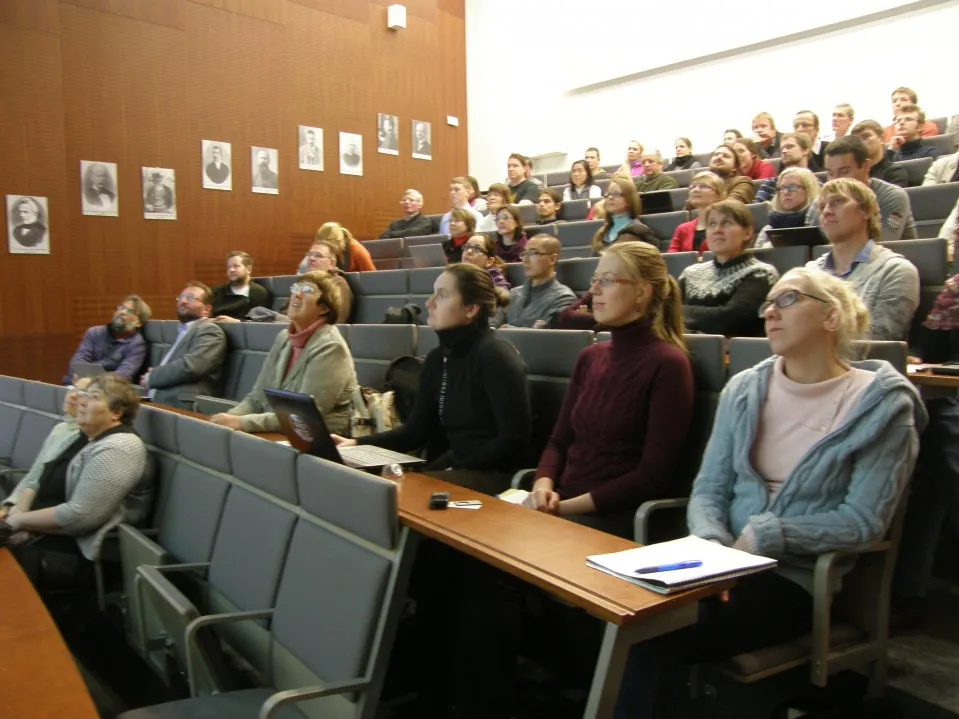
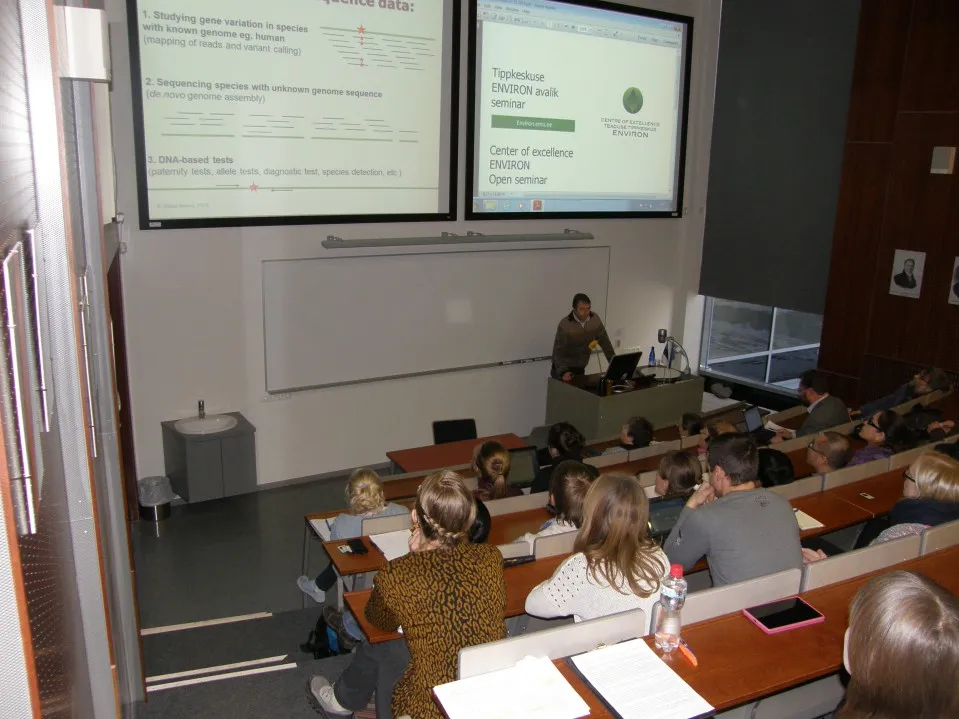

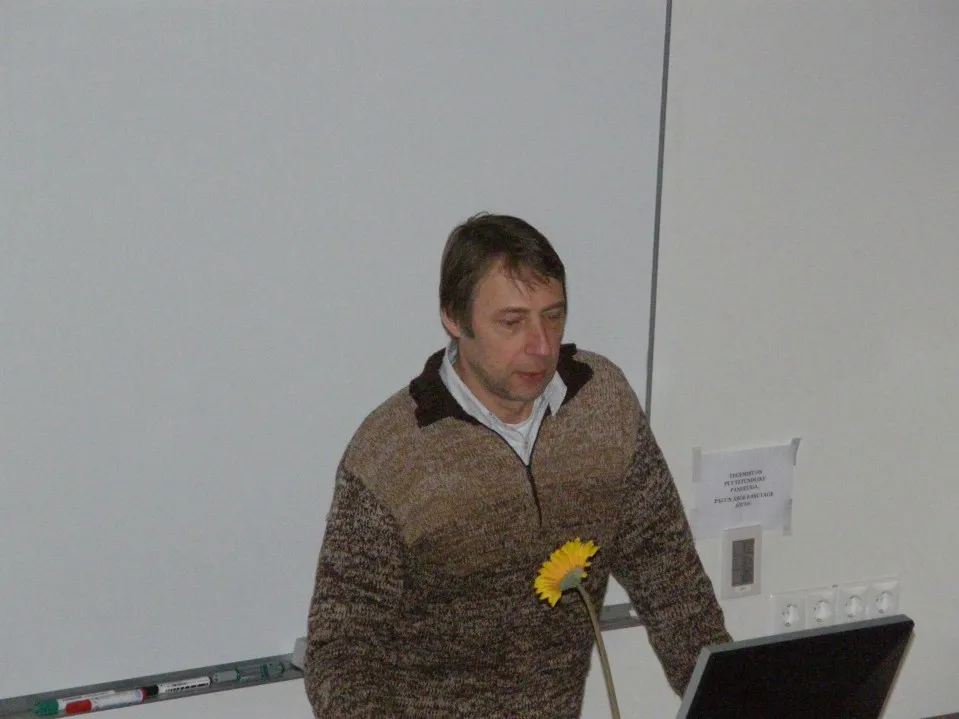
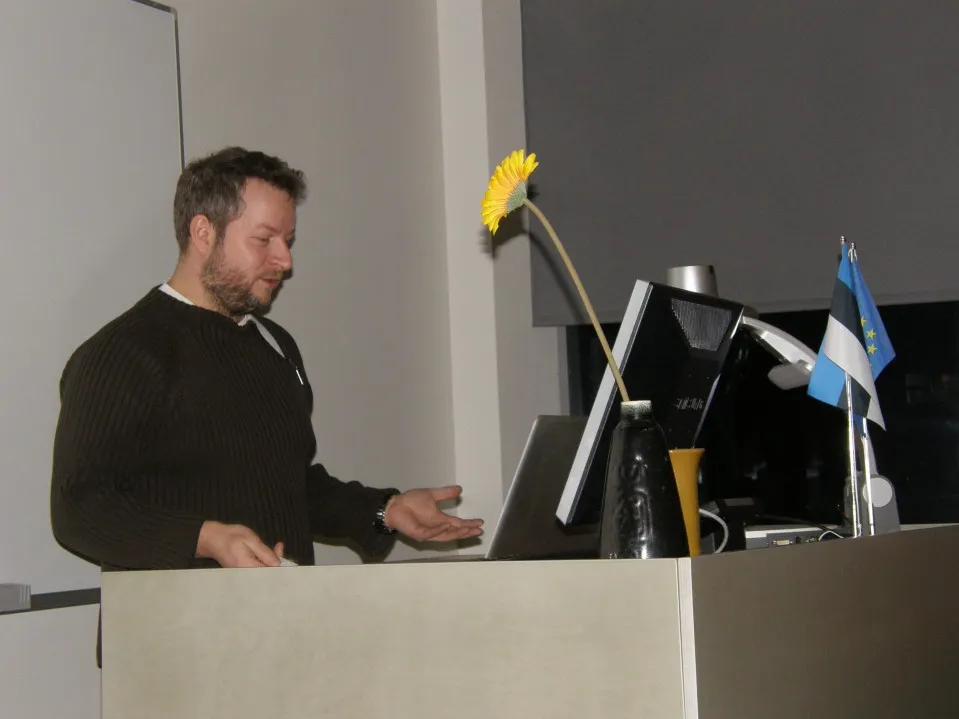
27.01.2014 ENVIRON seminar
Center of Excellence ENVIRON open seminars are starting - 27 January 2014
The Centre of Excellence in Environmental Adaptation ENVIRON invites everybody to participate on the seminar!
Aeg/Time: 27.01, 14.15-16.30
Koht/Place: Ravila 14A-1019 (Chemicum)
Ajakava/Programme:
14.15-14.55 Maido Remm (TÜ, invited guest, Head of the Centre of Excellence in Genomics) "From genome sequences to DNA-based diagnostic tests"
14.55-15.20 Teele Ligi (TÜ, PhD-student) "Characterisation of bacterial communities in soil and sediment of a created riverine wetland complex using high-throughput 16S rRNA amplicon sequencing"
15.20-15.35 paus (tee/kohv)
15.35-16.00 Ebe Merilo (TÜ, senior researcher) "To open or close - stomatal responses of different species in controversial environment: results and perspectives."
16.00-16.25 Steffen Noe (EMÜ, senior researcher) ”SMEAR Estonia - growing science around a new infrastructure”
Info: Tiia Kurvits ([email protected]) & Liina Jakobson ([email protected])
2013 Estonian student thesis contest
Among PhD-thesis in field of bio- and environmental sciences was the third price (700 Euros) awarded to Zhihong Sun for the contestwork "Isoprene emission from Aspen (Populus sp.) in relation to environmental drivers", supervisor Professor Ülo Niinemets, Estonian University of Life Sciences).
Seminars 2013
Josep Peñuelas "Walking from genes to biosphere for a better understanding of global change in terrestrial ecosystems". Prof. Josep Peñuelas Global Ecology Unit CREAF-CEAB-CSIC, Center for Ecological Research and Forestry Applications (CREAF) - National Research Council (CSIC), Barcelona
Albert Porcar-Castell "Optics of Photosynthesis: seasonal variation in leaf-level chlorophyll fluorescence and spectral reflectance". Dr. Albert Porcar-Castell Dosentti/Adjunct Professor Department of Forest Sciences University of Helsinki